
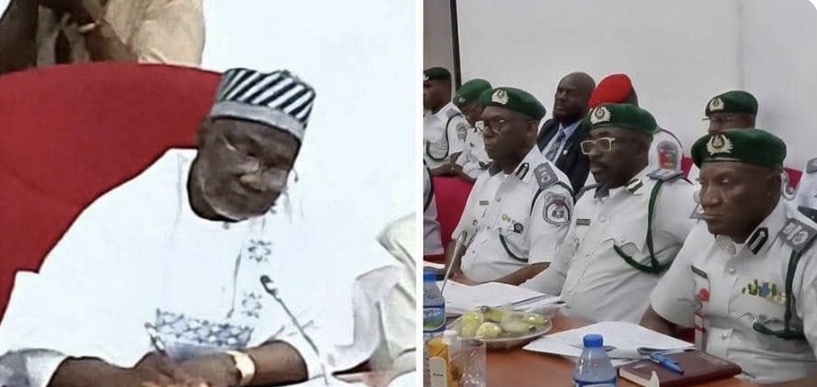

The Chairman of the Senate Committee on Customs, Senator Jibrin Echocho, has praised President Bola Tinubu for his continued support of ongoing reforms in the Nigeria Customs Service (NCS), saying the administration’s commitment has strengthened revenue generation, boosted investor confidence and enhanced economic activities.
Speaking during the defence of the Nigeria Customs Service’s 2026 budget proposal before the Senate Committee, Senator Echocho said the President had remained steadfast despite the challenges associated with the reform process.
He noted that the reforms have produced measurable results, including improved revenue performance, increased economic participation and stronger investor confidence.
The lawmaker also commended President Tinubu for approving a six-month extension of the Service’s mandate, describing the decision as an opportunity to consolidate ongoing reforms and achieve even greater results.
According to him, sustained engagement between the Senate Committee and the Nigeria Customs Service has helped improve revenue generation while advancing critical infrastructure projects aimed at facilitating trade, improving connectivity and delivering long-term benefits to Nigerians.
Echocho stressed that tax revenue remains one of the Federal Government’s key sources of income and urged the Customs Service to sustain the implementation of strategic reforms and projects throughout the 2026 fiscal year.
Presenting the Service’s budget performance, the Comptroller-General of Customs disclosed that the NCS surpassed its revenue target for the review period, generating ₦7.27 trillion between January and May 2026 against a target of ₦6.5 trillion.
He said the figure represented a 10.2 per cent increase over the corresponding period in 2025 despite prevailing policy and economic headwinds.
The Customs boss explained that the suspension of the proposed excise duty on telecommunications services and the non-implementation of the Green Tax adversely affected projected revenue. He added that duty waivers granted on essential imports, including food items, medical supplies, machinery and petroleum products, also reduced customs collections as part of the Federal Government’s economic relief measures.
According to him, imports covered by the waivers were valued at about ₦34.5 trillion, while only four of the eleven proposed excisable products were implemented during the period, limiting expected excise revenue.
He further noted that global developments, including the Russia-Ukraine conflict and tensions involving Iran, the United States and the Strait of Hormuz, continued to disrupt global supply chains and reduce cargo volumes, with implications for customs revenue projections.
Despite the challenges, the Comptroller-General said the Unified Customs Management System, B’Odogwu, is now fully operational across the nation’s ports, significantly improving customs administration, trade facilitation and revenue collection.
He added that the Service is intensifying revenue recovery efforts, modernising customs operations and expanding capacity-building programmes in collaboration with international development partners, including the World Bank, the International Monetary Fund (IMF) and the World Customs Organization (WCO).
On the 2026 fiscal proposal, the Comptroller-General disclosed that the Service has proposed a revenue target of approximately ₦1.235 trillion, with projected earnings expected from Free-on-Board (FOB) imports, VAT-related collections and receipts from capital projects.
He also outlined a proposed personnel expenditure of ₦421.77 billion, overhead costs of ₦300.77 billion and capital expenditure of about ₦1.65 trillion to fund infrastructure development, ICT expansion, equipment procurement, completion of ongoing projects and settlement of contractual obligations.
Reaffirming the Service’s commitment to accountability and transparency, the Comptroller-General assured lawmakers that the Nigeria Customs Service would continue to subject its operations to legislative oversight while strengthening trade facilitation and revenue generation.
He appealed to the Senate Committee to approve the proposed 2026 budget, expressing appreciation for its continued guidance and support.
