
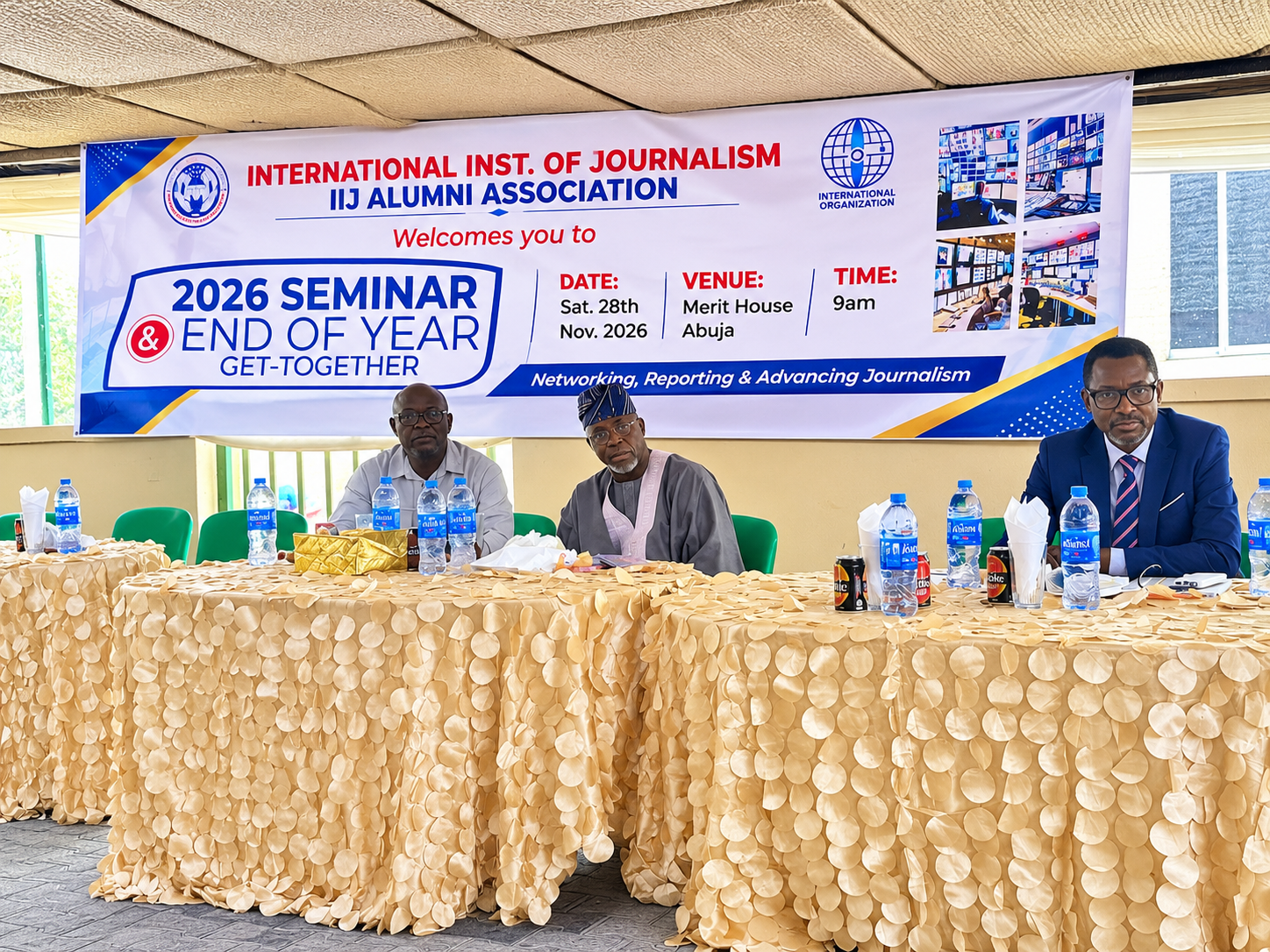

The International Institute of Journalism (IIJ) Alumni Association has called on Nigerian journalists to uphold professionalism, fairness and accountability in their reportage, particularly as the country approaches the 2027 general elections.
The association made the call at its 2026 Seminar and End-of-Year Get-Together, which brought together alumni, management of the institute and other stakeholders to deliberate on the challenges facing journalism and the future of the institution.
Speaking at the event, the Co-Chairman of the gathering, Ishaq Yahaya Malam, described the meeting as the first major gathering of the alumni association, aimed at providing a platform for members to interact, exchange ideas and discuss issues affecting journalism, the institute and the country.
Malam said the seminar, which focused on accountability, was also designed to provide an opportunity for political actors to explain their records in public office, their current positions and their plans for the future.
He urged journalists to ensure accurate and professional reportage, stressing that the political atmosphere ahead of the 2027 elections required responsible journalism.
Also speaking, retired Major General Benjamin Sawyer, who represented the alumni, described journalism as a powerful instrument capable of building or destroying nations.
Drawing from Nigeria’s political history and his military experience, Sawyer warned that irresponsible journalism could contribute to national instability, urging practitioners to prioritise facts, fairness and national unity.
The former Director of Information at the Defence Headquarters, who disclosed that he enrolled at IIJ in 2024 to obtain formal professional certification in journalism, said the profession carried enormous responsibility and should not be used to inflame tensions.
He recalled his participation in military operations in Liberia in 1992 and 1993, warning Nigerians against taking the prospects of war lightly.
“Never pray for war to happen. Honestly, I will tell you one thing: never, never pray for war to happen. Because even that journalism that you are practising, you will not be able to practise it again,” he said.
Sawyer urged journalists to remain fair in their reportage, base their stories on verifiable facts and promote national cohesion, irrespective of their individual political affiliations.
He expressed hope that participants would leave the seminar with a renewed commitment to responsible journalism and the preservation of national peace.
In his remarks, the Director of IIJ, Dr Emman Shehu, challenged the alumni association to take a leading role in addressing the institutional and financial challenges confronting the school.
Shehu expressed delight over the revival of the alumni association, describing its emergence as one of the significant achievements of his administration.
He explained that the institute had experienced several setbacks, including the loss of its original premises at Area 10, subsequent relocations and the financial difficulties associated with operating an educational institution without regular funding.
According to him, the institute initially benefited from international support through the International Organisation of Journalists, which facilitated the establishment of an international journalism training institution in Africa, with Nigeria eventually hosting the institute.
He regretted that the institute lost its original facilities, including accommodation and other infrastructure, following administrative and political developments surrounding the ownership and use of the property.
Shehu said the institute subsequently relocated to different temporary facilities before securing its present location.
He, however, warned that the institute’s survival remained threatened by inadequate funding, noting that reliance on students’ fees alone was insufficient to sustain its operations.
The director called on the alumni to partner with the institute in organising professional training programmes and short-term courses that could generate revenue and strengthen its capacity.
He also urged members to work collectively towards restoring IIJ to its original vision as an international centre for journalism training in Africa.
“The survival of IIJ rests squarely on the shoulders of the alumni,” Shehu said, adding that collective intervention was necessary to reposition the institution and secure its future.
Earlier, the Patron of the association, retired Major Professor Aku Andrew Amboson, expressed excitement over the gathering, describing it as an important opportunity for old and new members to reconnect and discuss ways of improving the institute.
Amboson called for sustained engagement among members and stronger partnerships with organisations, particularly the Nigeria Union of Journalists (NUJ), to rebuild the institution and enhance its standards.
He urged alumni to demonstrate excellence in their professional assignments, stressing that their conduct and performance would reflect on the institution where they received their training.
With the 2027 elections approaching, the patron cautioned journalists against sensational and divisive reporting, noting that the media had the potential to either promote national unity or aggravate tensions.
He urged practitioners to be patriotic, truthful and guided by professional ethics, regardless of their religious or political affiliations.
“Be someone who is ready to raise the mic and tell people the truth. Be someone who is ready to present facts. Don’t destroy anybody,” he advised.
In his welcome address, the President of the IIJ Alumni Association, Dr Reuben Okala, expressed appreciation to members and dignitaries who attended the gathering.
Okala acknowledged the contributions of the institute’s management, the patron and other stakeholders towards reviving the association, which he said had remained inactive for several years.
He also introduced the panelists drawn from different political parties, who were expected to engage participants on political accountability and issues surrounding the country’s leadership ahead of the 2027 elections.
The event provided an opportunity for alumni to renew professional relationships, examine the challenges confronting journalism and explore ways of contributing to the development of the institute.
