
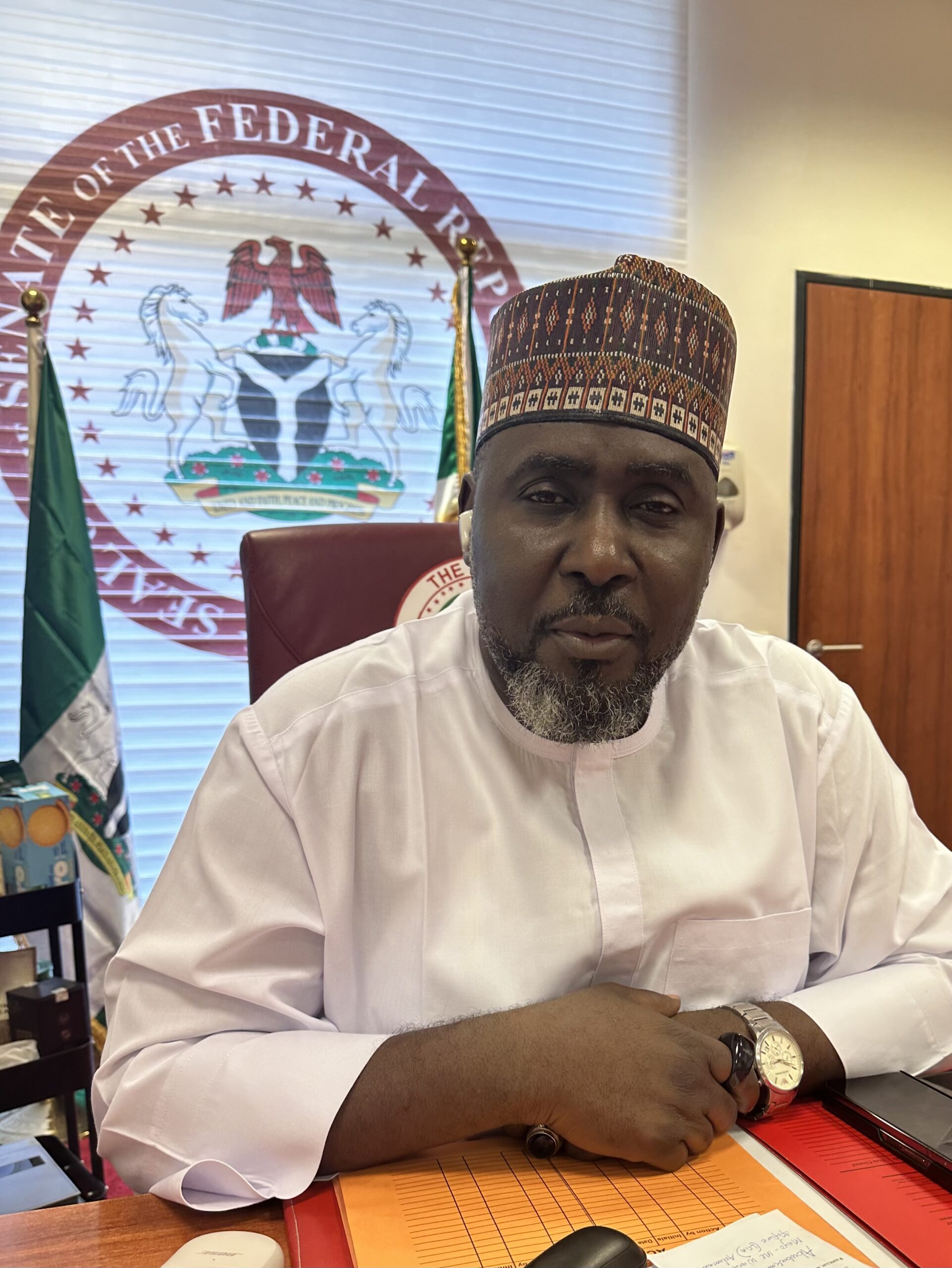

The Chairman of the Senate Committee on Science and Technology, Senator Aminu Iya Abbas, has urged the federal government to harmonize mining regulations and licensing with state governments, protect host communities and prevent displacement of landowners than targeting unemployed youths involved in informal mining activities.
Abbas, who represents Adamawa Central Senatorial District, said the government should introduce stringent safety regulations and appropriate conditions for mining activities instead of imposing measures that could further impoverish unemployed young people.
The senator spoke against the backdrop of the recent death of some young miners in Niger State following their arrest, an incident that was brought before the Senate.
He argued that while illegal mining must be regulated, the government should recognise the economic circumstances pushing many young Nigerians into the activity.
“There is no reason for targeting those young men. However, you can put stringent conditions that may stop them from entering certain areas or require them to meet specific standards before engaging in mining.
“You can stipulate that miners must be of a certain age and possess the necessary equipment to protect themselves. But targeting people who are simply looking for something to eat is not acceptable to me.
“We did not provide them with jobs, and they have to survive. If somebody has to find a means of livelihood, you don’t need to stop that person from doing so,” he said.
Abbas noted that informal mining activities were widespread across the country, with many young people abandoning farming and other traditional occupations because of the immediate financial benefits associated with mining.
He disclosed that even in his constituency, young people had increasingly turned to mining, including the extraction of sand, which he said attracted buyers, including foreign operators.
According to him, the government should pay closer attention to the buyers and operators financing the activities rather than concentrating enforcement efforts on vulnerable youths carrying out the mining.
The lawmaker, however, identified what he described as fundamental weaknesses in Nigeria’s mining administration, particularly the disconnect between the Federal Government, which issues mining licences, and state governments, which control land allocation.
He explained that while the Federal Government grants mining licences, state governments are responsible for land allocation and the issuance of Certificates of Occupancy, creating conflicts when mining rights are granted without adequate consultation with landowners and host communities.
Abbas lamented that individuals could obtain mining licences in Abuja and subsequently enter communities to exploit mineral resources without the knowledge or consent of the people occupying or owning the land.
He said the situation had resulted in disputes, destruction of farmlands and possible displacement of rural communities whose livelihoods depend on the affected lands.
“How can somebody own land, and you give a mining licence without consulting the owner? Before issuing such a licence, you are supposed to consult the state and establish who occupies or owns that particular area.
“If there is a need for compensation, it should be provided. But people are given licences without the state government knowing who owns them. Some of the licence holders are even foreigners,” he said.
The senator stressed that mining licences should not be issued without proper engagement with state governments and affected communities, insisting that the people whose lands are being exploited must be recognised and adequately compensated.
Using a practical example, Abbas questioned how a person could obtain the right to mine inside another individual’s property simply because geological surveys or GPS technology indicated the presence of gold or other mineral deposits beneath the land.
He said such situations were particularly common in rural communities, where residents might have acquired and occupied their lands for generations before suddenly being confronted by mining operators claiming legal rights over the properties.
The lawmaker maintained that the situation required urgent intervention through improved coordination between the Federal Government and state governments.
“I think there is a need for the Federal Government and state governments to sit down together and work out modalities that will solve all these issues.
“Even if you are giving somebody a licence, the state must know who is being given the licence and the particular area covered. The community must also be involved,” he said.
Abbas also raised concerns about the environmental and security implications of poorly regulated mining activities, recalling an incident in his state in which a mining-related dam reportedly collapsed, causing flooding that led to loss of lives and destruction of homes.
He said although there were disagreements over the exact circumstances surrounding the incident, the situation demonstrated the dangers of mining operations carried out without adequate government oversight.
According to him, state governments were often left without sufficient information or control over mining operations taking place within their territories, making it difficult to monitor environmental compliance and hold operators accountable.
He warned that the consequences of unregulated mining extended beyond the activities of informal miners to include environmental degradation, destruction of agricultural land, community displacement and loss of lives.
The senator therefore called for a comprehensive review of the country’s mining regulatory framework, stressing that the Federal Government must work closely with state governments to ensure that mining licences are properly issued, monitored and enforced.
He maintained that efforts to tackle illegal mining should strike a balance between regulating the sector, protecting vulnerable Nigerians seeking livelihoods and safeguarding the rights of landowners and host communities.
Abbas said addressing the structural problems surrounding mining licenses, land ownership and government supervision would be more effective than focusing enforcement measures solely on young people engaged in informal mining.
