
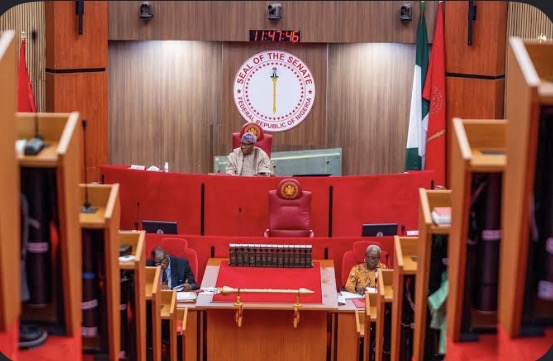

The Senate has condemned the growing incidence of political violence, intolerance and attacks on political leaders, candidates and their supporters across the country, warning that the trend poses a serious threat to Nigeria’s democracy ahead of the 2027 general election.
The upper chamber consequently urged security agencies to investigate reported cases of political violence, identify and prosecute their perpetrators and sponsors, while mandating its relevant committees to engage security institutions and report back within one week on measures to prevent further attacks.
The resolutions followed a motion sponsored by Senator Abdul Ningi, titled, “Need to Check the Rising Incidence of Political Violence, Political Intolerance and Attacks on Political Leaders and Supporters Across Nigeria.”
Leading the debate, Ningi expressed concern over what he described as a disturbing pattern of political intolerance, intimidation and violence, citing several incidents involving political gatherings and prominent political figures across the country.
He specifically referenced the violent disruption of a political procession involving supporters of the NDC and other political movements in Asaba on November 7, 2026, which reportedly resulted in one death and five injuries.
He also cited the reported attack on the convoy of former Vice President and African Democratic Congress (ADC) presidential candidate, Atiku Abubakar, in Sokoto State, as well as attacks on political candidates and stakeholders during gatherings in Benue and Edo states.
According to him, the incidents could undermine public confidence in the electoral process and discourage citizens from exercising their democratic rights.
Ningi warned that failure to investigate and prosecute those responsible for political violence could encourage further attacks, deepen political divisions and threaten the peaceful conduct of the 2027 general election.
He reminded lawmakers that Sections 39 and 40 of the 1999 Constitution, as amended, guarantee freedom of expression, peaceful assembly and association, including political association.
He maintained that political differences should be resolved through peaceful engagement and the contest of ideas rather than intimidation, violence or suppression of opposing views.
Seconding the motion, Senator Ali Ndume described it as urgent and important, noting that he had personally observed several incidents of political violence within the preceding two weeks.
Ndume commended the Senate leadership for prioritising the matter, stressing that the increasing incidents required immediate legislative intervention before they escalated.
Contributing to the debate, Senator Ndume strongly condemned the reported attack on President Bola Tinubu during Friday prayers at a mosque in the Area 1, Garki, Abuja, describing the incident as unacceptable and contrary to the sanctity of a place of worship.
He argued that political grievances should never be expressed through violence, particularly against a sitting president during religious activities.
He also praised Tinubu for what he described as an act of democratic tolerance and magnanimity following the incident, disclosing that 88 persons arrested in connection with the disturbance were released within 24 hours on the President’s directive.
He said the President’s action demonstrated fatherliness and restraint, noting that a leader with a military mentality might have responded differently.
He, however, warned that political violence could spread rapidly if not decisively addressed.
He urged the Police and Armed Forces to prohibit the carrying of weapons and other dangerous objects to political campaign grounds.
He insisted that campaign grounds should be places for displaying candidates’ posters and communicating political ideas rather than carrying sticks, knives and other harmful objects.
Senator Kawu Ismaila took a critical position on the issue, blaming politicians and political candidates for sponsoring the violence they publicly condemn.
He alleged that politicians across party lines routinely encourage youths to attend political gatherings with dangerous weapons and drugs, thereby creating an environment conducive to electoral violence.
According to him, the problem must be addressed from its source by holding political candidates accountable for the conduct of their supporters.
He said: “We are sponsoring all what is going on in our campaign. Let us tell ourselves the truth. It is a shame for us to see a candidate of the Senate, House of Representatives or a Governor carrying a dangerous weapon, with thugs surrounding him. We are encouraging it.”
The lawmaker argued that candidates whose supporters were found carrying dangerous weapons during campaigns should face prosecution.
He also proposed the establishment of a special court to handle electoral violence, insisting that political sponsors should not escape responsibility while young people recruited to perpetrate violence bear the consequences.
“If we are considering constituting a special court, let the candidate be prosecuted. Whenever you are cited in your campaign, your people carrying dangerous weapons, you will be responsible for all what happened,” he said.
He further condemned the Area 3 Juma’at Mosque incident, stressing that attacking a leader inside a mosque, particularly during Friday prayers, was unacceptable.
However, the senator cautioned security agencies against excessive and provocative handling of political crowds, citing an incident during the North-West presidential campaign launch in Kaduna.
He alleged that supporters arriving at the stadium with party flags and wearing campaign shirts were subjected to tear gas by security operatives, describing such conduct as potentially capable of creating unnecessary tension and being perceived as political sabotage.
He called for restraint and professionalism by security agencies, while urging politicians to practise what they preach by ensuring their supporters comply with existing laws.
The Minority Leader, Senator Abba Moro supported the motion, describing it as a timely intervention against the growing deterioration of Nigeria’s political culture.
He said violence, whether physical or expressed through abusive language and attacks on social media, should be condemned, particularly when directed at the President of the country.
According to him, the reported attack on Tinubu should compel the political class to undertake a serious examination of the country’s political culture and the increasing tendency to disrespect political institutions and leaders.
He warned that the normalisation of verbal and physical attacks against political opponents could further weaken democratic values.
The Minority Leader also supported stronger legislative action, stressing the need for the Senate to take a firm position before the situation deteriorates further.
Senator Babagida Husaini, Jigawa North West while supporting the motion, called attention to Nigeria’s failure to implement critical recommendations contained in the 2008 Justice Mohammed Uwais Electoral Reform Committee report.
He recalled that the committee, inaugurated by the late President Umaru Musa Yar’Adua, made extensive recommendations on addressing electoral violence, including a two-tier institutional framework involving a commission and a tribunal.
He said the recommendations were subsequently reviewed and approved by former President Goodluck Jonathan, who directed the Attorney-General of the Federation to initiate their implementation, but the necessary action was not taken.
The senator also recalled that in 2018, the Chairman of the Independent National Electoral Commission (INEC), Professor Mahmood Yakubu, raised concerns about the commission’s limited institutional capacity to prosecute electoral offences and deal effectively with electoral violence.
He regretted that successive governments and relevant institutions had failed to address the problem despite repeated warnings.
The lawmaker further alleged that a political candidate in his state had publicly brandished a pistol during a political activity without any visible action being taken against him.
When asked to identify the political party involved, he named the African Democratic Congress (ADC).
He insisted that the reported incident demonstrated the need for serious enforcement of electoral laws rather than repeated condemnations without concrete action.
The senator urged the Senate to use its constitutional position to make firm recommendations and ensure that electoral offenders and their sponsors were held accountable.
He also supported reducing the period for the relevant committees to submit their report from four weeks to one week, arguing that the urgency of the situation demanded immediate action.
In his contribution, the Senate President warned that political violence was often sponsored and could escalate if the political class continued to tolerate the perpetrators.
He argued that certain political actions and public conduct, including the rejection of court judgments without pursuing appropriate judicial remedies, could create an atmosphere that encourages violence.
He also cautioned against conduct capable of undermining established national institutions and democratic processes, urging politicians to focus on issue-based campaigns rather than personal attacks.
The Senate President subsequently drew the attention of lawmakers to provisions of the Electoral Act 2026, particularly Sections 121 to 128, which address electoral offences, including intimidation, ballot box snatching, BVAS snatching and other forms of electoral violence.
He said the law provides for imprisonment ranging from 12 months to five years for specified offences, with no option of a fine for aggravated cases involving acts such as stoning and attacks with dangerous objects.
He also referred to Section 92, which, according to him, empowers INEC to suspend elections in areas where violence is reported, with provision for rescheduling within 24 hours.
The Senate President further referenced the Electoral Offences Commission Bill 2025, which he said provides for a dedicated institutional mechanism to handle electoral offences, including thuggery, vote-buying and violence against INEC personnel.
He maintained that the responsibility now rested on the executive and relevant institutions to implement the laws already enacted by the National Assembly.
In a significant revelation, the Senate President said the Electoral Act 2026 empowers INEC to disqualify a candidate whose agents are established to have incited violence, provided the commission establishes a prima facie case.
He cited the reported incident involving a candidate who allegedly brandished a pistol during a political activity, saying that if the evidence was authentic and not manipulated using artificial intelligence, INEC could invoke the relevant provisions against the candidate.
He urged lawmakers to draw INEC’s attention to its powers under the Act, irrespective of the political party involved, insisting that political candidates who encourage supporters to carry dangerous weapons should face the consequences.
According to him, such decisive action would send a strong message to politicians who allegedly sponsor youths to perpetrate violence during campaigns.
Following deliberations, the Senate adopted a series of resolutions aimed at preventing political violence and safeguarding the 2027 general election.
First, the chamber urged the Federal Government to direct the Inspector-General of Police and other relevant security agencies to strengthen security arrangements for political leaders, candidates, supporters and political gatherings nationwide.
It also called for effective early-warning and rapid-response mechanisms to prevent political violence ahead of the 2027 elections.
Secondly, the Senate urged relevant security agencies to conduct thorough, impartial and transparent investigations into reported incidents in Abuja, Edo, Delta and Sokoto states, as well as other affected areas, with a view to identifying the perpetrators and sponsors and ensuring their prosecution in accordance with the Electoral Act 2026.
The chamber also adopted an amendment moved by Senator Kano to reduce the reporting period for its relevant committees from four weeks to one week.
The amendment mandated the Committees on National Security and Intelligence, Police Affairs, and the Independent National Electoral Commission to engage relevant institutions and report back to the Senate within one week on measures to prevent political violence and safeguard the 2027 general election.
The amendment was seconded by Senator Kaka Shehu Lawan, representing Borno Central, and subsequently adopted.
In another resolution, Senator Binus Yaro, representing Adamawa South, raised concerns over alleged political intolerance by some state governors who reportedly deny opposition parties access to hotels, public arenas and other facilities for political activities.
He urged governors to guarantee equal opportunities for all political parties by allowing rival candidates and political organisations access to public facilities under their control.
Seconding the additional prayer, the Minority Leader, Abba Moro supported the call for a level playing field, while the Senate President clarified that the resolution covered public arenas, stadiums and other facilities controlled by state governments.
The additional prayer was subsequently adopted by the chamber.
The Senate also adopted an additional prayer moved by Senator Samson Ekong, urging the Federal Ministry of Information and the National Orientation Agency (NOA) to embark on an intensive nationwide enlightenment campaign against political violence.
Ekong argued that legislation alone would not be sufficient to address the problem without sustained public awareness, particularly among young people who are often recruited by politicians to perpetrate violence during campaigns.
He urged the agencies to educate citizens on the criminal consequences of electoral violence and draw attention to the relevant provisions of the Electoral Act 2026.
The senator condemned the practice of politicians allegedly using other people’s children to carry weapons, throw stones and attack political opponents, insisting that no responsible politician would encourage his own children to engage in such activities.
He said the proposed enlightenment campaign should make it clear that electoral violence attracts serious criminal penalties.
The prayer was seconded by Senator Dike Plang and adopted by the Senate.
In his closing remarks, the Senate President thanked Ningi for bringing the motion before the chamber and commended senators who contributed to the debate.
He expressed hope that the resolutions, if properly implemented, would help rid the country of electoral violence and promote peaceful political participation ahead of the 2027 general election.
He also emphasised the importance of the proposed public enlightenment campaign in educating young people about the criminal consequences of violence during campaigns, elections and post-election activities.
The Senate President again commended President Tinubu for directing the release of the 88 persons arrested following the disturbance involving his convoy after the Friday prayers at the Area 3 mosque in Garki, Abuja.
He described the presidential intervention as an act of fatherliness, while urging those involved to desist from further acts capable of threatening public order.
The Senate maintained that political violence, regardless of the political party or individuals involved, must not be tolerated, warning that the credibility and peaceful conduct of the 2027 general election depend largely on the willingness of political leaders, security agencies and relevant institutions to enforce existing laws.
