
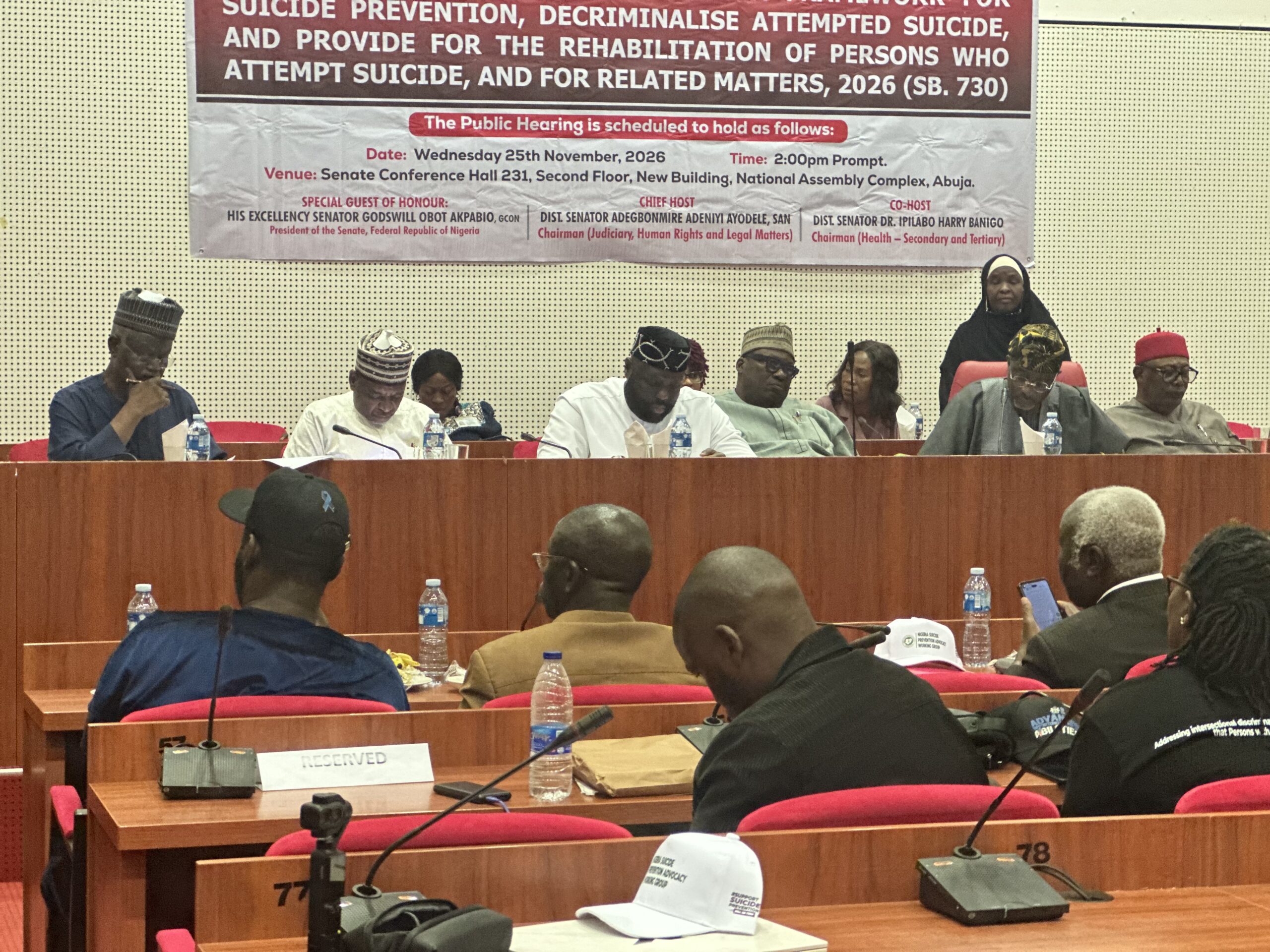

The Chairman of the Senate Committee on Judiciary, Human Rights and Legal Matters has said economic hardship should not be regarded as the only factor responsible for suicide attempts, stressing that the proposed legislation seeks primarily to remove criminal punishment for survivors and provide them with medical and psychological support.
The senator, speaking with journalists after a public hearing on the Suicide Prevention Bill sponsored by Senator Asuquo Ekpenyong (Cross River South), explained that the legislation was not designed to address the circumstances that drive individuals to attempt suicide but to change the state’s response to survivors.
He said while poverty, economic hardship, family challenges, abuse and other personal circumstances could contribute to suicidal behaviour, the central issue before the Senate was whether someone who survives a suicide attempt should face prosecution or receive protection and treatment.
According to him, the existing law criminalises attempted suicide, despite the recognition of suicide attempts as psychiatric emergencies under the National Mental Health Act.
“The very essence is not the reason for the attempt. It is the act itself, to say that act should no longer be punishable. People should be looked at with sympathy. People should be looked at with understanding. They should be looked at with help,” he said.
The committee chairman noted that stakeholders who participated in the public hearing expressed support for decriminalisation, although some proposed amendments to strengthen the bill.
He said the Senate was committed to listening to Nigerians and incorporating relevant recommendations before finalising the legislation.
On concerns that the bill should focus more on suicide prevention than decriminalisation, the lawmaker explained that suicidal behaviour was complex and could result from several factors beyond economic circumstances.
He listed mental health challenges, family problems, abuse and personal experiences among possible triggers, adding that even wealthy individuals could experience depression.
He stressed that depression was an illness requiring medical attention and that people experiencing suicidal thoughts needed reassurance that they would not be treated as criminals for seeking help.
The chairman, however, clarified that decriminalising attempted suicide would not provide protection for anyone who encourages, procures or assists another person to commit suicide.
He maintained that such actions would remain criminal offences under the law.
“What we are looking at decriminalising is those who attempt suicide and survive, because we understand that, based on the Mental Health Act of 2023, this is a psychiatric emergency and requires intervention, treatment, rehabilitation and the preservation of life,” he said.
The lawmaker described suicide as a serious public health concern that should not be trivialised or treated as a subject of ridicule.
He explained that the proposed legislation was informed by the contradiction between the Mental Health Act, which recognises attempted suicide as a psychiatric emergency, and Sections 327 of the Criminal Code and 231 of the Penal Code, which provide for punishment.
He said resolving the legal inconsistency was part of the responsibility of lawmakers.
Ekpenyong impressed by stakeholders’ support
Meanwhile, the sponsor of the bill, Senator Asuquo Ekpenyong, expressed satisfaction with the participation and submissions made by stakeholders at the public hearing.
He thanked representatives of government institutions, civil society organisations, non-governmental organisations, health professionals and people with lived experiences for contributing to the legislative process.
Ekpenyong said the large turnout demonstrated the importance Nigerians attached to the subject, noting that the Senate plenary hall could barely accommodate the participants.
He disclosed that the committee would review all submissions, including those from the Federal Government, which has also presented an executive bill seeking to decriminalise attempted suicide.
According to him, the objective is to produce a comprehensive legal framework that reflects the interests of Nigerians and provides effective protection for people who survive suicide attempts.
“We’ve been in there deliberating and receiving submissions from several stakeholders for several hours. I’m quite impressed with the turnout, and the turnout shows that this is an all-important subject for Nigerians,” he said.
The senator added that the Senate committees would examine the recommendations and proposed amendments before proceeding with further legislative action.
The public hearing attracted representatives of the Federal Ministry of Health and Social Welfare, Nigerian Law Reform Commission, Nigeria Police Force, psychiatric hospitals, the Association of Psychiatrists in Nigeria and the Nigerian Psychological Association, among other stakeholders.
While expressing support for decriminalisation, several participants called for harmonisation of the proposed legislation with the existing National Mental Health Act and the executive amendment bill to avoid duplication and conflicting provisions.
