
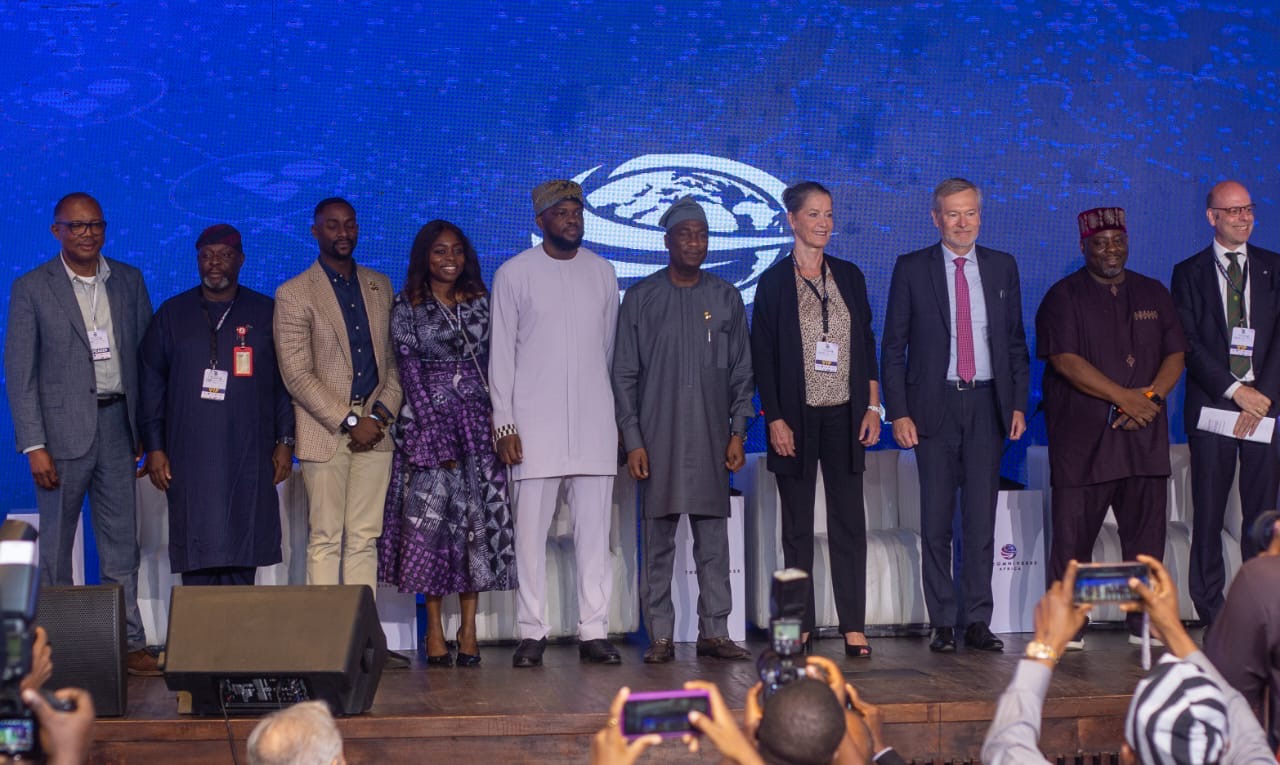

Deputy Speaker of the House of Representatives, Rt. Hon. Benjamin Okezie Kalu, PhD, CFR has disclosed that the 10th National Assembly is translating policy understanding into legislative action to position Nigeria for a digital-led future, with a focus on data protection, cybersecurity, and expanded broadband access for underserved communities.
Kalu made the disclosure, Wednesday in Abuja while delivering his remarks at the Official Digital Switchover by the Nigerian Communications Satellite Limited (NIGCOMSAT), a Nigerian government-owned company that manages the nation’s communications satellite.
He commended President Bola Ahmed Tinubu, GCFR for prioritising a digital-led growth strategy within the Renewed Hope Agenda, aimed at expanding economic growth and strengthening global competitiveness.
He said: “The National Assembly is translating policy understanding into legislative action. Under the leadership of the Speaker, Rt. Hon. Abbas Tajudeen, the 10th House is advancing reforms to strengthen Nigeria’s digital future, including stronger data protection and cybersecurity, incentives to expand
affordable broadband to underserved communities, legislation to promote local digital content and skills development, and updated spectrum management policies to ensure efficient use of national digital assets across broadcasting, telecommunications, and satellite services.
“This legislative direction aligns with the broader vision of the Tinubu-led Government, which has placed the digital economy at the centre of Nigeria’s economic transformation agenda. I commend President Bola Ahmed Tinubu for prioritising a digital-led growth strategy within the Renewed Hope Agenda, aimed at expanding economic growth and strengthening global competitiveness.”
The Deputy Speaker noted that the National Assembly is also working closely with the Federal Ministry of Communications, Innovation and Digital Economy, under Minister Bosun Tijani, to strengthen the legal and institutional framework for the transformation.
“The National Assembly continues to work closely with the Federal Ministry of Communications, Innovation and Digital Economy, under Minister Bosun Tijani, to strengthen the legal and institutional framework for this transformation.
“This includes the development of the National Digital Economy and E-Governance framework to support digital services, cybersecurity, and secure data exchange across government, alongside ongoing investments in national fibre-optic expansion and broader connectivity for millions of previously unconnected Nigerians across all geopolitical zones”, he said.
Kalu further stressed that the Digital Switchover is not an isolated event but part of a coordinated national effort to build a modern digital economy that works for all Nigerians.
“It is part of a coordinated national effort to build a modern digital economy that works for all Nigerians. Digital transformation of this scale requires collaboration between government, the private sector, academia, and development partners, a regulatory environment that enables innovation while protecting the public interest, and a shared commitment to intentionally build the future.
“That future is already unfolding as artificial intelligence reshapes productivity, satellite systems expand communication, and digital platforms redefine how societies learn and trade. The question before Nigeria is whether we will shape these changes or merely adapt to them; we must choose to lead, not only as consumers of innovation, but as contributors to the technologies that define the future”, Kalu said.
The Deputy Speaker highlighted the strategic role of satellite infrastructure, commending NIGCOMSAT for its critical role in powering the technological backbone of this digital transition.
He said that satellite systems extend connectivity to underserved areas, strengthen national security, and support digital access where terrestrial networks are limited.
“I commend the National Broadcasting Commission for driving this important national project, and I particularly recognise NIGCOMSAT for its critical role in powering the technological backbone of this digital transition.
“Satellite infrastructure has become a strategic national capability, extending connectivity to underserved areas, strengthening national security, and supporting the expansion of digital access where terrestrial networks remain limited.
“The nations that will prosper in the decades ahead are not necessarily those with the greatest natural resources, but those that succeed in connecting their people to knowledge and opportunity, investing in human capital, and building ecosystems where innovation can thrive.
The true measure of today’s Digital
Switchover will therefore not be technical alone, but developmental: whether it expands opportunity, reduces inequality, and improves the lives of ordinary Nigerians.
“If history records anything from today, it should not only be that Nigeria completed a technological transition. It should also record that Nigeria deepened its commitment to becoming a fully digital nation, where innovation is enabled, talent is empowered, and opportunity is broadly shared.
“When a nation connects its people, it unlocks its potential. When it empowers its innovators, it accelerates its prosperity. And when it chooses to build the future before the future arrives, it secures its place in history. May this Digital Switchover mark another decisive step in Nigeria’s journey toward that future”, he said.
Kalu called on all stakeholders to choose to lead, not just consume innovation, but contribute to the technologies that define the future.
