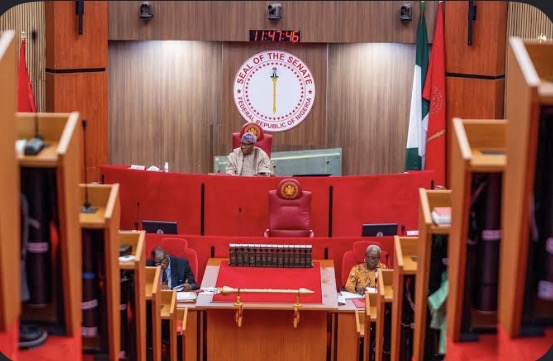

The Senate has considered the report of its Committees on Petroleum Downstream and Gas on the confirmation of six nominees for appointment as Executive Directors of the Nigerian Midstream and Downstream Petroleum Regulatory Authority (NMDPRA), with a warning against actions capable of undermining President Bola Tinubu’s petroleum sector reforms.
The report was presented by Senator Suleiman Abdulrahman Kawu (Kano South), who urged the Senate to receive and consider the committees’ recommendations on the nominees.
The nominees are Mr. Abiodun A. Adeniji for Executive Director, Finance and Accounts; Mr. Ogbugo Kalu Ukoha for Executive Director, Distribution Systems, Storage and Retailing Infrastructure; and Dr. Mustapha Lamorde for Executive Director, Health, Safety, Environment and Community.
Others are Mr. Mobolaji Tajudeen Musa for Executive Director, Hydrocarbon Processing Plants, Installations and Transportation Infrastructure; Ms. Ogechukwu Modie for Executive Director, Economic Regulation and Strategic Planning; and Mr. Said Abutalib for Executive Director, Corporate Services and Administration.
Three of the nominees, Adeniji, Ukoha and Lamorde, are returning executive directors nominated for reappointment, while Musa, Modie and Abutalib are new nominees.
Their nominations followed a request by President Tinubu seeking Senate confirmation of the appointments to key positions in the regulatory agency.
During their screening, Chairman of the Senate Committee on Downstream Petroleum, Senator Sumaila Kawu, warned the nominees against conduct capable of frustrating the administration’s petroleum sector reforms.
Kawu, who spoke during the screening by the Senate Joint Committee on Downstream Petroleum and Gas, expressed concern that administrative bottlenecks, inefficiency and deliberate non-compliance by some government agencies were frustrating government policies and eroding public confidence.
Although he did not identify the agencies or provide specific examples, he urged the nominees to uphold the law, demonstrate integrity and accountability, and ensure effective implementation of government policies within their respective mandates.
The senator also urged them to consider the impact of petroleum-sector reforms on households and businesses, noting that rising fuel prices had increased the cost of transportation, food and other essential commodities.
He called for practical and sustainable regulatory measures that would help ease the economic hardship faced by Nigerians.
The NMDPRA is responsible for regulating Nigeria’s midstream and downstream petroleum sectors, including petroleum processing, distribution, storage and retail infrastructure.
The appointments are expected to strengthen the authority’s management structure and regulatory capacity as the Federal Government continues efforts to reposition the petroleum industry.
