
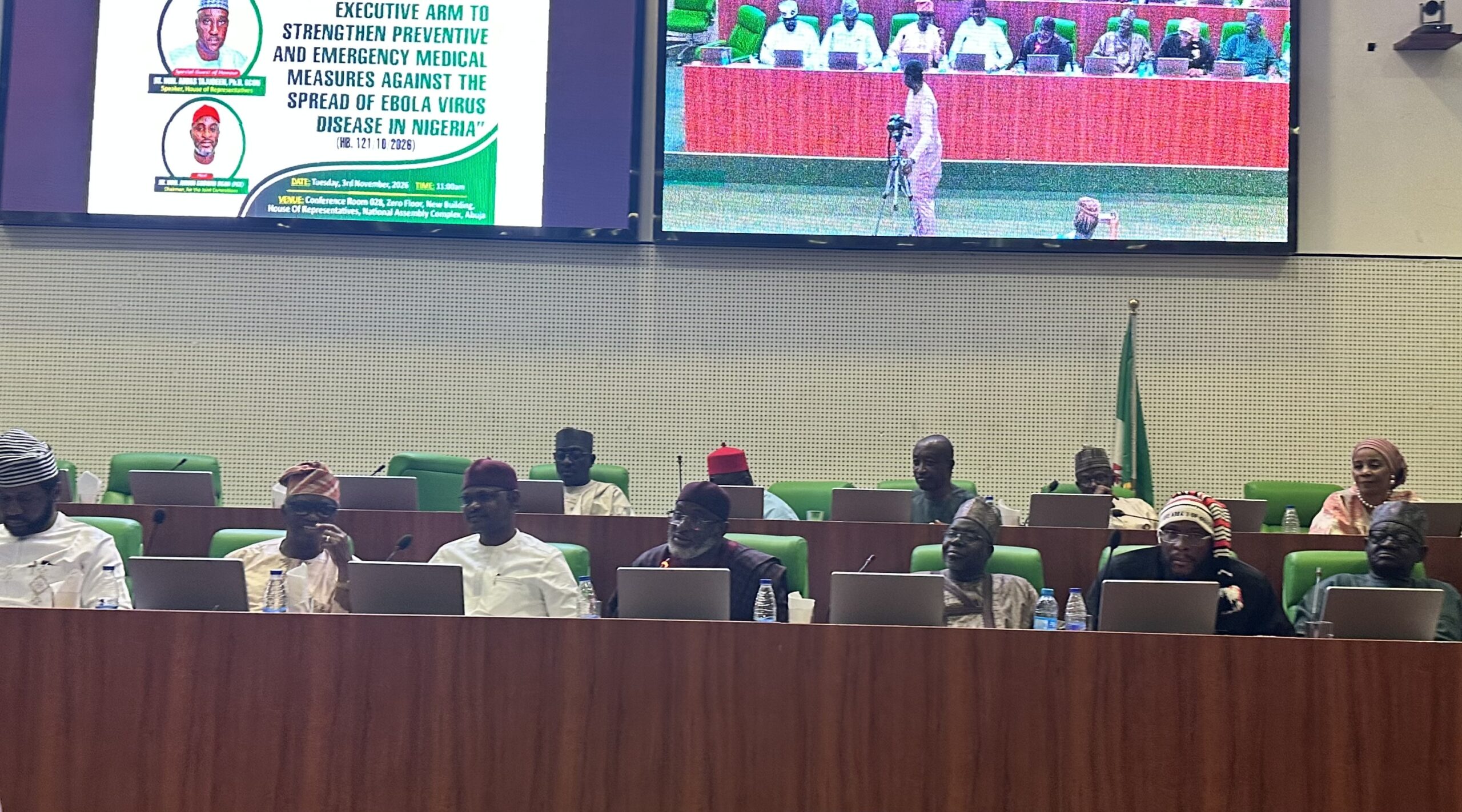

The House of Representatives has expressed its resolve to scrutinize the coordination of government agencies, timely release and transparent utilization of emergency health funds, as well as the preparedness of state governments to respond effectively to public health emergencies.
The Speaker of the House, Hon. Abbas Tajudeen, stated this on Tuesday while declaring open a one-day public hearing on the outbreak of Ebola Virus Disease (EVD) in Nigeria in Abuja.
Tajudeen, who was represented by Hon. Billy Osawaru, said the recent Ebola outbreak in parts of Africa and the confirmation of an imported case in Nigeria had underscored the urgent need to strengthen the country’s public health security architecture.
He described public health security as an integral component of national security, noting that disease outbreaks originating outside the country could quickly become matters of national concern in an increasingly interconnected world.
The Speaker commended the Federal Government’s response to the development, including the activation of emergency mechanisms, strengthening of surveillance and contact tracing, establishment of a Presidential Task Force and approval of emergency funding.
However, he cautioned against complacency, stressing that the evacuation of the confirmed imported case and the absence of established onward transmission should reinforce the country’s commitment to preventing future outbreaks.
According to him, Nigeria’s experience during the 2014 Ebola outbreak demonstrated that early detection, decisive intervention and effective coordination were critical to containing infectious diseases.
He explained that the public hearing was part of the legislature’s constitutional responsibility to assess national preparedness, evaluate the effectiveness of relevant institutions and determine whether existing legal, financial and operational frameworks were sufficient to protect Nigerians.
Tajudeen said the exercise would examine the capacity of disease surveillance systems to detect threats early, the adequacy of laboratories and isolation facilities, the availability of protective equipment and training for healthcare workers, as well as screening arrangements at airports and border communities.
He added that the House would investigate whether emergency health funds were released promptly and utilised transparently, while identifying gaps in the capacity of state governments to manage public health emergencies.
The Speaker emphasised that disease containment could not be left to the Federal Government alone, insisting that all tiers of government must understand and fulfil their responsibilities.
He also called for accurate and consistent public communication to prevent misinformation and unnecessary panic, assuring Nigerians that the hearing was not intended to create alarm, particularly as there were no active Ebola cases in the country.
He assured that the House would give serious consideration to the submissions and recommendations arising from the hearing and pursue appropriate legislative and administrative interventions.
Speaking earlier, Chairman of the Joint Committees on Infectious Diseases, Healthcare Services, Aviation and Interior, Hon. Amobi Ogah, said the news of the Ebola outbreak in October had generated widespread anxiety among Nigerians.
Ogah said he received several calls and enquiries from constituents and fellow lawmakers seeking clarification on the country’s preparedness and the measures being implemented to prevent the spread of the disease.
Recalling Nigeria’s experience during the 2014 Ebola outbreak, the Abia lawmaker noted that the epidemic had inflicted significant physical, psychological and economic damage on the country, resulting in the deaths of several prominent Nigerians.
He said the concerns generated by the recent development prompted the House to initiate high-level consultations and subsequently organise the public hearing to assess the preparedness of critical government agencies.
Ogah particularly expressed concern about the vulnerability of international airports as potential entry points for infectious diseases, urging relevant agencies to explain the screening arrangements and preventive measures in place for passengers entering and leaving the country.
He commended President Bola Tinubu for the prompt establishment of the Presidential Task Force on Ebola and the release of N10 billion to support containment efforts.
The lawmaker also praised the Nigeria Centre for Disease Control and Prevention (NCDC) for coordinating the national response, expressing optimism that reports indicating that two additional suspected cases identified in the North-East had tested negative would strengthen the country’s prospects of containing the disease.
Meanwhile, the Controller-General of the Nigerian Correctional Service (NCoS), Sylvester Nwakuche, has called for the inclusion of custodial centres in Nigeria’s national Ebola preparedness strategy, warning that their population density and shared facilities could increase the risk of disease transmission.
Nwakuche said infectious disease outbreaks in correctional facilities could have serious consequences for inmates, personnel, visitors and surrounding communities, making early detection and effective infection prevention measures imperative.
He disclosed that the service was strengthening disease surveillance, infection prevention and control, emergency response arrangements and collaboration with the NCDC, Federal Ministry of Health and Social Welfare, and state health authorities.
The Controller-General, however, identified inadequate medical infrastructure, protective equipment, trained personnel, emergency isolation spaces and medical transportation as critical challenges requiring government intervention.
He urged the Federal Government to integrate correctional facilities into national and subnational public health emergency preparedness programmes.
Nwakuche also called for dedicated funding, regular training of correctional officers and healthcare personnel, improved medical referral arrangements, periodic assessment of custodial centres and provision of essential medical supplies.
He maintained that strengthening the preparedness of correctional institutions would not only improve the country’s response to Ebola but also enhance its capacity to prevent and manage other infectious disease threats.
I can also produce a stronger version with the House of Representatives and Speaker Abbas as the dominant news angle, while retaining the contributions of the other stakeholders.
