
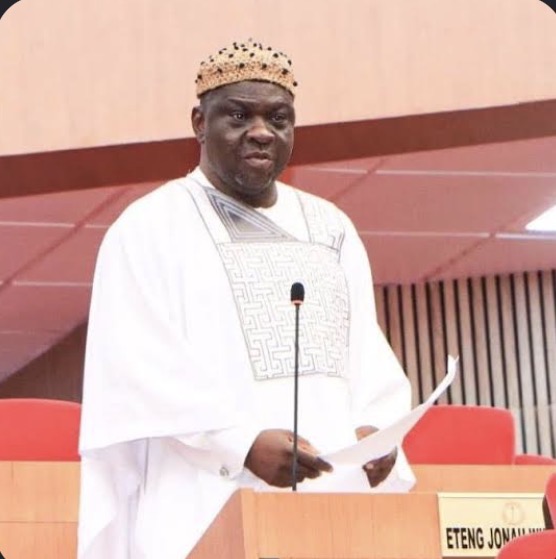

Senator representing Cross River Central Senatorial District, Eteng Jonah Williams, has called for stiffer penalties for human trafficking and stricter enforcement of existing laws, saying the failure to punish offenders decisively remains a major obstacle to ending the menace in Nigeria.
Williams, who spoke in an interview on efforts to combat human trafficking and illegal migration, said Nigeria already had relevant legislation addressing human trafficking and child labour but needed to strengthen the provisions through amendments and ensure their effective implementation.
He specifically advocated amendments to the existing laws to impose tougher sanctions on individuals and organisations involved in trafficking, child exploitation and other related offences.
According to him, the effectiveness of any legislation depends largely on the willingness of relevant authorities to enforce it without fear or favour.
“We have laws on child labour and trafficking. We should look at them as legislators and make amendments where necessary to introduce stiffer penalties for offenders. That will help.
“But enforcement of these laws is very important. Whoever commits a crime should be properly punished, irrespective of the person’s position, background or where they come from. That is the only way we can get out of it,” he said.
The senator, however, clarified that while the legislature was responsible for making laws, the responsibility for enforcing them and punishing offenders rested primarily with the executive and the judiciary.
He said the challenge required effective collaboration among the three arms of government, stressing that the separation of powers must translate into practical action against trafficking networks.
“That is where separation of powers comes in. We, as lawmakers, make the laws. The executive enforces them, while the judiciary punishes offenders. The change must be complete,” he added.
On the increasing Japa syndrome and the growing number of Nigerian youths seeking opportunities abroad through irregular migration channels, Williams cautioned against desperation and the pursuit of what he described as the fast lane to success.
He advised young Nigerians to remain productive, acquire relevant skills and explore legitimate opportunities, whether within the country or abroad.
“There is no easy way. Stay here and do your work. If you study well and want to travel abroad for greener pastures, do it legitimately. Don’t try the fast lane. The fast lane does not pay because it has consequences,” he said.
The lawmaker warned that many Nigerians embarking on irregular migration journeys were often unaware of the laws, risks and conditions in their destination countries, leaving them vulnerable to exploitation, imprisonment and other severe consequences.
He cited the strict drug laws in some countries as an example, noting that individuals who unknowingly become involved in drug trafficking could face extremely harsh penalties.
Williams urged prospective migrants to understand the legal implications of their actions and avoid being deceived by individuals and agencies promising easy passage or lucrative opportunities abroad.
Addressing concerns over unemployment and the difficult economic conditions driving young Nigerians to seek opportunities outside the country, the senator acknowledged the challenges but urged citizens to contribute to rebuilding the economy.
He said the government was making efforts to improve the country’s economic situation and appealed to Nigerians to give the administration of President Bola Tinubu time to address existing challenges.
According to him, national development requires collective commitment from both government and citizens, including those operating in the private sector.
“The government of the day is trying its best. Our best might not be enough, but we should give them time. We will get there.
“If you are selling plantain, for instance, you should work hard to develop that business and make something meaningful out of it. You must get busy,” he said.
While acknowledging that many professionals, including medical doctors and other skilled Nigerians, were leaving the country in search of better opportunities, Williams said he did not blame them for seeking improved living conditions.
However, he maintained that Nigerians could also achieve meaningful success at home if adequate efforts were made to develop the economy and create opportunities.
“I don’t blame them. They are trying to make ends meet, but you can also stay back and achieve those same results. If all of us move out, who will stay back to make Nigeria work? We have to stay back and make Nigeria better,” he said.
The senator’s comments come against the backdrop of renewed legislative efforts to tackle human trafficking and the exploitation of Nigerians abroad.
The Senate had recently ordered a comprehensive multi-agency investigation into travel agencies allegedly involved in the illegal trafficking, enslavement and exploitation of Nigerian citizens in Libya.
The resolution followed the adoption of a joint committee report presented by Senator Anthony Yaro (APC, Gombe) during plenary on October 27.
The report, jointly prepared by the Senate Committees on Diaspora and Non-Governmental Organisations; Judiciary, Human Rights and Legal Matters; Foreign Affairs; and Special Duties, recommended a coordinated investigation involving the National Agency for the Prohibition of Trafficking in Persons (NAPTIP), Nigeria Police Force, Nigeria Immigration Service, Economic and Financial Crimes Commission and the Federal Ministry of Foreign Affairs.
The Senate also called for stricter enforcement and possible review of the Trafficking in Persons (Prohibition) Enforcement and Administration Act, 2015, and the Child Rights Act, 2003, as well as increased funding for NAPTIP.
Other recommendations included establishing a National Reintegration and Protection Programme for returning victims and strengthening diplomatic engagements with Libyan authorities to dismantle trafficking networks and promote safe and legal migration channels.
The resolutions further highlighted the need to address security gaps within the country that could allow criminal networks to operate undetected.
