
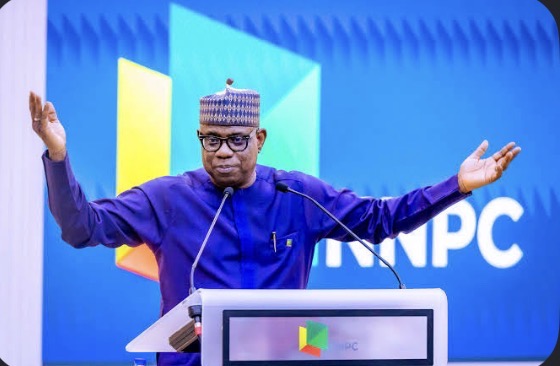

The Centre for Reforms and Good Governance (CRGG) has credited reforms at the Nigerian National Petroleum Company Limited (NNPCL) under Group Chief Executive Officer, Engr. Bashir Bayo Ojulari, with improving public confidence in President Bola Ahmed Tinubu’s administration.
In a statement signed by its Executive Director, Maxwell Onazi, the Centre described Ojulari’s tenure, which began with his appointment on April 2, 2025, as a significant phase in the commercialisation, professionalisation and restructuring of Nigeria’s national oil company.
According to the group, the NNPCL leadership has recorded gains in crude oil production, financial performance, transparency, infrastructure development, cost management and investor confidence.
CRGG said the developments were consistent with the objectives of the Federal Government’s Renewed Hope Agenda, arguing that the performance of the national oil company demonstrated the potential impact of appointing professionals with a results-oriented approach to strategic public institutions.
“Engr. Bayo Ojulari has shown that with disciplined leadership, commercial focus and commitment to transparency, NNPCL can be transformed from a historically loss-making entity into a profitable, investor-ready national asset,” Onazi said.
He cited the company’s reported financial performance as evidence of the changes, noting that NNPCL recorded ₦19.04 trillion in revenue and ₦2.28 trillion in profit after tax between January and June 2026.
The Centre also highlighted statutory remittances to the Federation Account, which it said stood at ₦6.286 trillion during the first half of 2026 and rose to ₦7.913 trillion by the end of July, including ₦1.627 trillion remitted in July alone.
“These figures are concrete indicators of improved financial performance and disclosure,” Onazi said.
“When citizens see consistent remittances, increased production and greater transparency from a strategic national institution, it can strengthen confidence in the broader reform programme of the administration.”
CRGG further pointed to developments in the upstream sector, saying national crude oil production remained above 1.7 million barrels per day for much of 2026, with production reaching about 1.73 million barrels per day at its peak.
It also cited increased output from NNPC Exploration and Production Limited, which reportedly reached about 365,000 barrels per day, as well as stronger gas production, which stood at 7,841 million standard cubic feet per day in June 2026.
The Centre said progress had also been recorded on major gas infrastructure projects, including the Ajaokuta-Kaduna-Kano (AKK) and Obiafu-Obrikom-Oben (OB3) pipelines, which it said had reached 94 per cent and 98 per cent completion respectively.
According to the organisation, major upstream projects, including Bonga Southwest-Aparo, have also continued to advance, while contract reviews and other cost-optimisation measures reportedly generated $3.4 billion in savings.
“These are not isolated developments. Increased production, stronger gas output, progress on strategic pipelines and cost savings point to an NNPCL undergoing significant operational and commercial changes,” Onazi said.
The CRGG maintained that the reported performance under Ojulari had strengthened the case for continued reforms within the oil and gas sector.
It urged stakeholders to sustain support for ongoing reforms and ensure that gains recorded in production, revenue generation, transparency and investment are consolidated for long-term national benefit.
