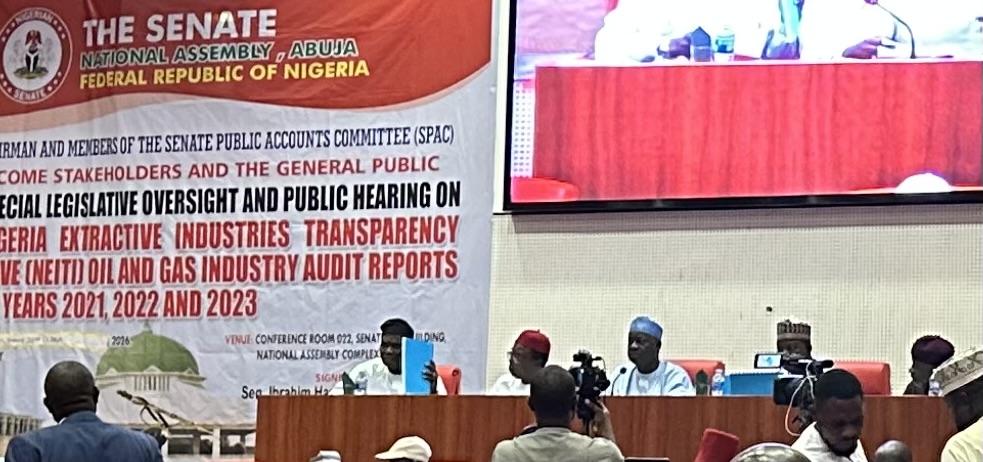

The Senate Committee on Public Accounts has resolved to summon the heads of the Nigerian Midstream and Downstream Petroleum Regulatory Authority (NMDPRA), Nigerian National Petroleum Company Limited (NNPCL) and the Nigeria Extractive Industries Transparency Initiative (NEITI) over discrepancies in their records of petrol imports between 2021 and 2023.
The committee said the conflicting figures raised concerns about the accuracy of reported petroleum import volumes and required a thorough investigation to establish the reasons for the differences.
The decision followed a session on Tuesday at which NMDPRA officials appeared before the committee to respond to queries arising from NEITI’s Oil and Gas Industry Audit Report covering 2021 to 2023.
The NMDPRA Chief Executive, Rabiu Umar, was represented at the session by a Deputy Director, Uzoamaka Ugwu-Ojobe, who defended the authority’s records despite significant differences with figures submitted by NNPCL.
Ugwu-Ojobe said the authority recorded 3.29 billion litres of Premium Motor Spirit (PMS), commonly known as petrol, imported into the country in 2022 and 6.02 billion litres in 2023.
However, NNPCL’s records indicated that 6.27 billion litres were imported in 2022 and 3.88 billion litres in 2023.
“We stand by 3.29 billion litres of PMS as volume imported in 2022 and 6.02 billion litres as volume imported in 2023 against 6.27 billion litres recorded by NNPCL in 2022 and 3.88 billion litres in 2023,” she said.
The NMDPRA representative described the differences as slight, adding that the agencies were examining the figures with a view to reconciling their records.
Her explanation, however, failed to satisfy members of the committee.
Senator Abdul Ningi (PDP, Bauchi Central) rejected the suggestion that the discrepancies were minor, insisting that the differences were too substantial to be dismissed without a detailed investigation.
Ningi said the conflicting figures were disturbing and demanded clear explanations rather than assurances that the agencies were working towards reconciliation.
Similarly, Senator Dayo Faduyile (APC, Ondo South) expressed concern that the differences raised questions about the reliability of the reported figures.
Senator Anietan Bassey (PDP, Akwa Ibom North-East) also called for a comprehensive investigation to establish the reasons for the discrepancies and safeguard the country’s interests against potential losses.
Following the submissions, the committee, chaired by Senator Ibrahim Dankwambo (PDP, Gombe North), rejected the NMDPRA’s defence and resolved to convene a joint meeting involving the three agencies.
The planned meeting is expected to provide an opportunity for the agencies to examine their respective records and explain why they reported substantially different volumes of petrol imports for the same periods.
The investigation comes amid public concern over petrol prices and the cost of living, with Nigerians continuing to grapple with high fuel prices.
Meanwhile, the Federal Government has dismissed reports that it plans to introduce a five per cent tax on retail petroleum products.
In a statement posted on his X account, the Minister of State for Finance, Taiwo Oyedele, said the government had no plan to introduce a fuel tax.
“In my interview with Arise News, I was clear: a fuel tax is not on the table,” Oyedele wrote.
His clarification followed reports suggesting that President Bola Tinubu’s administration was considering a five per cent tax on retail petroleum products, a development that had raised concerns about a possible further increase in petrol prices.
With petrol reportedly selling between N1,370 and N1,429 per litre in some locations, the introduction of an additional tax could increase the financial burden on consumers.
Some reports had attributed the proposed tax to Oyedele, prompting him to clarify his position and reiterate that a fuel tax was not under consideration.
While the Senate committee’s investigation focuses on discrepancies in petroleum import records, the minister’s statement addresses speculation about a proposed fuel tax. The two developments have renewed attention on petroleum-sector transparency, government policy and the financial pressures facing consumers.
